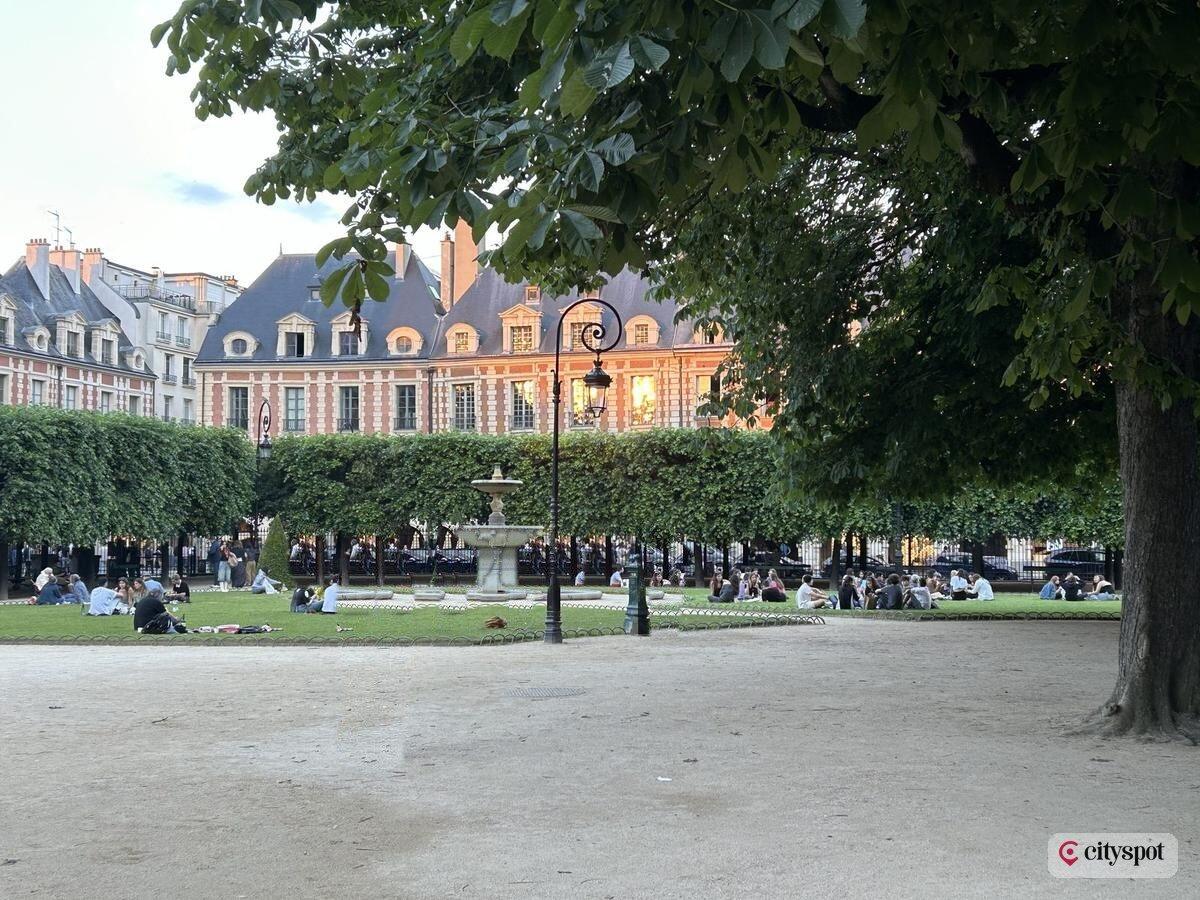
Place des Vosges — Photo: property of CitySpot
Right Bank · 3rd & 4th arrondissements
Le Marais: Where a Drained Swamp Became Paris's Grandest Address
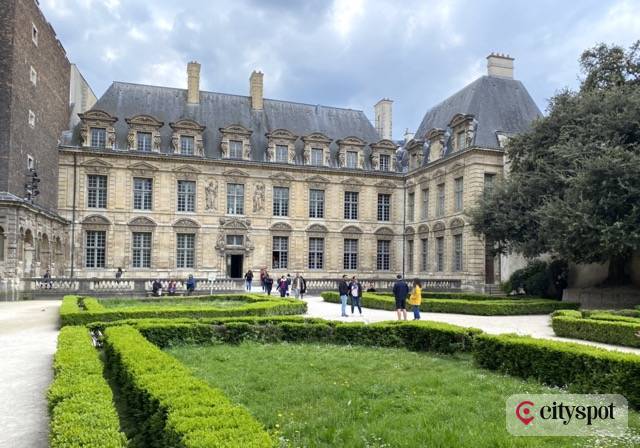
Once a marsh drained by monks in the 13th century, Le Marais blossomed into Paris's grandest address after Henri IV built the Place Royale, today's Place des Vosges, between 1605 and 1612, the first planned square in the city. Aristocratic families filled the neighborhood with their hôtels particuliers through the 1600s, then drifted toward Saint-Germain, leaving the Marais to workshops and crowded tenements for two centuries. A 1960s preservation law saved its facades from demolition and set off the slow revival that makes it, today, one of the most walkable and best-preserved corners of old Paris: arcaded squares, hidden courtyards, and narrow medieval lanes all within a few blocks of each other.
Modern life has layered itself on top without erasing any of that history. Rue des Rosiers, the heart of the Pletzl, Paris's historic Jewish quarter, is still lined with falafel counters and delicatessens that have fed the neighborhood for generations, while around them independent galleries, concept stores, and some of the city's liveliest LGBTQ+ nightlife make the Marais feel thoroughly of-the-moment too. Spend an afternoon drifting between the Musée Carnavalet, which tells the story of Paris itself, and the Musée Picasso inside the Hôtel Salé, and you will have covered both halves of what makes this neighborhood special.
The Marais is best explored on foot. Rue des Francs-Bourgeois links the Hôtel de Soubise to Place des Vosges, and rue de Sévigné and rue de Thorigny lead to the Musée Carnavalet and the Musée Picasso. For a break, head to the covered Marché des Enfants Rouges on rue de Bretagne, or browse the boutiques of rue Vieille-du-Temple.
Victor Hugo lived on Place des Vosges for sixteen years, but the square has another, less familiar claim to fame: it briefly lost its royal name altogether. During the Revolution it was renamed Place de l'Indivisibilité, part of a wave of renamings meant to scrub the city of anything that smelled of monarchy. It only became Place des Vosges in 1800, honoring the first French département to pay its revolutionary war taxes in full, a slightly bureaucratic reward for a very grand square.
More from the history books
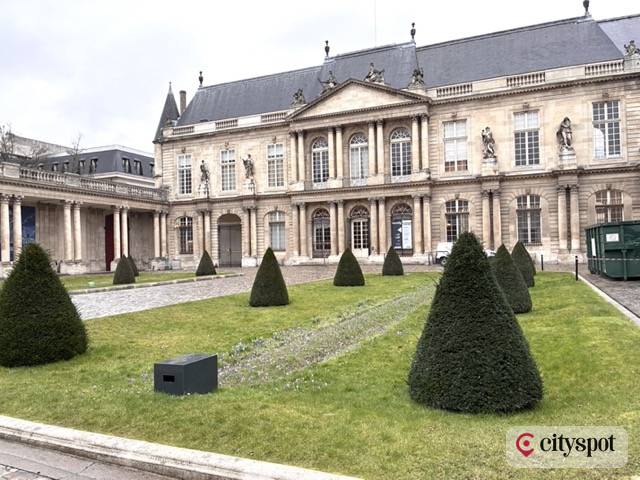
Before the aristocracy moved in, the Marais had a darker royal chapter. In 1559, King Henri II was fatally wounded in a jousting tournament held on rue Saint-Antoine, beside the royal Hôtel des Tournelles. His widow, Catherine de' Medici, could not bear the place and had the palace demolished, and the empty plot it left behind is exactly where Henri IV later laid out the Place Royale.
The neighborhood's Jewish community, present in the area since the Middle Ages and swelled by arrivals from Eastern Europe in the 19th and 20th centuries, centered on rue des Rosiers and rue des Écouffes. The round-ups of 1942 emptied many of its homes, and small plaques on local school walls still name the children who never came back. The district's architectural survival, by contrast, owes much to the 1962 Malraux law, which helped make the Marais one of the first protected historic sectors in France and paved the way for the restoration of its mansions.
3 key numbers
1605 — the year work began on Place des Vosges, the first planned square in Paris
36 — matching brick-and-stone pavilions ring the square, built to one unified design
2 centuries the Marais spent half-forgotten before a 1960s law saved its facades
We recommend…
- 📍 Place des Vosges — Place des Vosges · Metro: Saint-Paul
- 📍 Musée Carnavalet — 23 rue de Sévigné · Metro: Saint-Paul
- 📍 Musée Picasso — 5 rue de Thorigny · Metro: Saint-Sébastien–Froissart
- 📍 Hôtel de Soubise (Archives nationales) — 60 rue des Francs-Bourgeois · Metro: Rambuteau
- 📍 Marché des Enfants Rouges — 39 rue de Bretagne · Metro: Filles du Calvaire
Did you know?
- The Marais's name literally means "the marsh," a reminder that the ground beneath it was waterlogged until monastic orders drained it.
- Madame de Sévigné, whose letters are still read as a portrait of 17th-century court life, was born on Place des Vosges — the same square where Victor Hugo later lived.
- Cardinal Richelieu once owned a mansion facing the square; it has since been absorbed into the ring of arcades you can still walk under today.

Explore Le Marais with CitySpot
Download the CitySpot app and turn your phone into an audio guide to discover 500 points of interest in Paris, as well as many themed walking tours across the city.