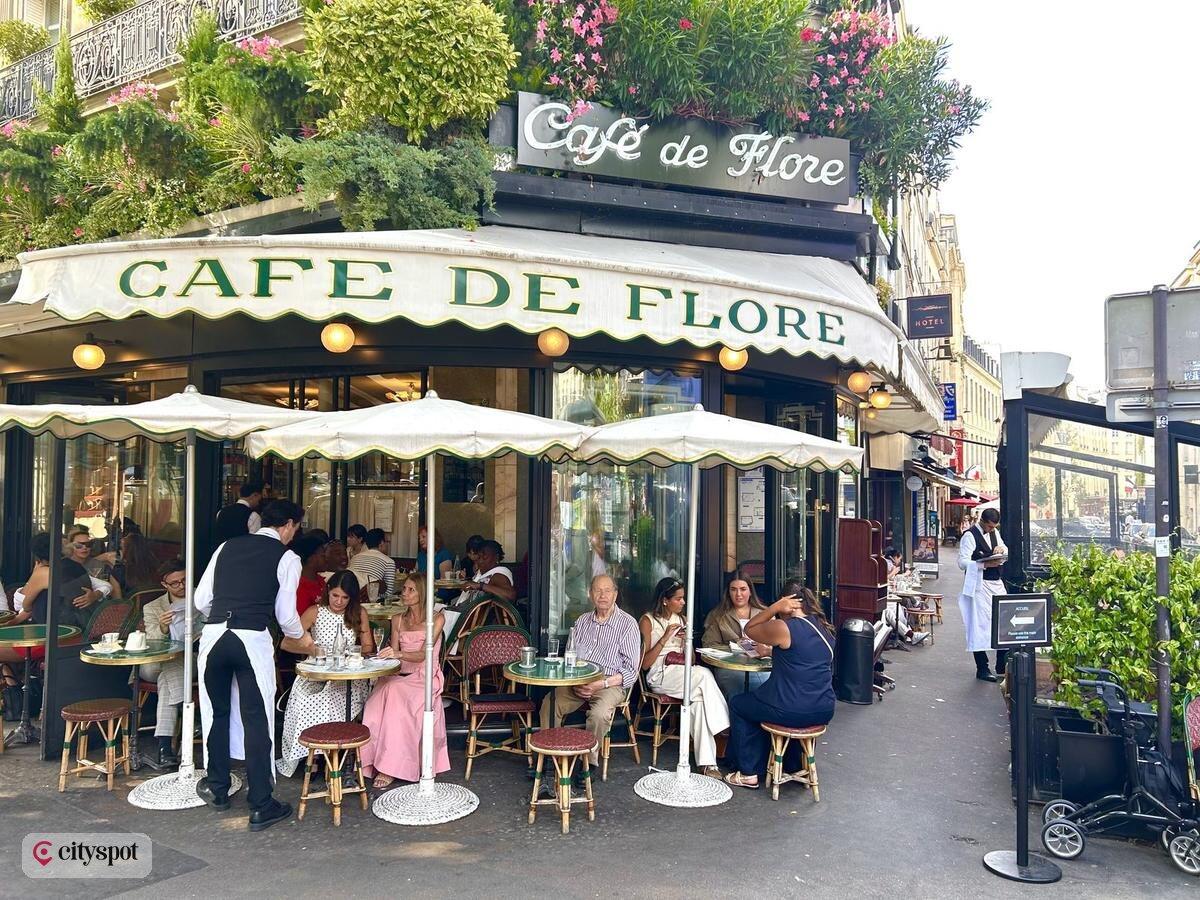
Café de Flore — Photo: property of CitySpot
Left Bank · 6th arrondissement
Saint-Germain-des-Prés: Where Paris's Oldest Church Meets Café Philosophy
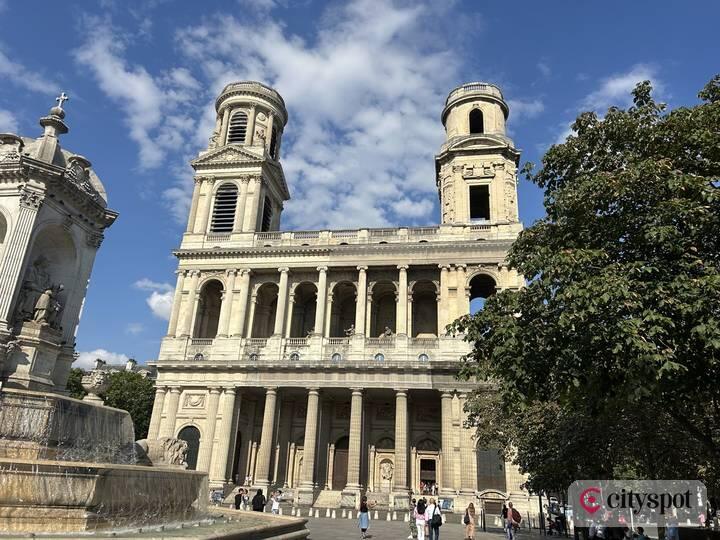
Named for the Benedictine abbey founded here in the 6th century, once the richest and most powerful in France, Saint-Germain-des-Prés grew up as the abbey's market town before blooming into a literary and intellectual hub in the decades after the Second World War. Its abbey church is the oldest surviving church in Paris, its squat Romanesque tower still visible above the square, all that remains of a vast abbey complex.
Visit the Église Saint-Germain-des-Prés itself, browse the publishing-house bookshops that still line the surrounding streets, and sit, as generations of writers have, at Café de Flore or Les Deux Magots, the twin cafés where existentialism was argued into being over endless cups of coffee. The neighborhood's café culture isn't nostalgia dressed up for tourists: Sartre, Beauvoir, and their circle genuinely treated these tables as an extension of their apartments.
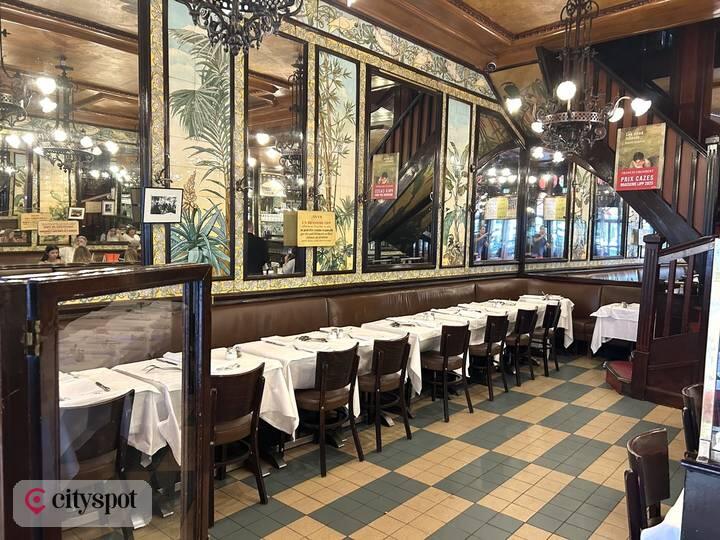
The heart of the Left Bank's literary life runs along boulevard Saint-Germain, where Café de Flore (no. 172) and Brasserie Lipp (no. 151) are still gathering places. Turn into rue de Buci for its market stalls, rue de Seine for art galleries, and rue de Furstemberg for one of the prettiest little squares in Paris, home to the Musée Delacroix. Place Saint-Sulpice and its church lie a few minutes' walk to the southwest.
Sartre and Beauvoir reportedly wrote for hours at Café de Flore partly to escape their unheated apartments: the café's stove, not its philosophy, was the original draw. Centuries earlier, the philosopher René Descartes was buried in the abbey church, where part of his tomb still remains today, after being shuffled between several resting places during the upheavals of the Revolution.
More from the history books
The abbey was founded around 558 by the Merovingian king Childebert I, who had returned from a campaign in Spain with relics of Saint Vincent, and for centuries it served as a royal burial place before the kings moved to Saint-Denis. Its bell tower dates from around the year 1000, making it one of the oldest in France, a survivor of a monastery that was burned by Vikings in the 9th century and rebuilt more than once.
For centuries the abbey's grounds also hosted the Foire Saint-Germain, one of the great fairs of Paris, which drew merchants and entertainers for weeks each year until the Revolution; the covered Marché Saint-Germain, built in the early 19th century, stands on part of its site. The abbey itself did not survive the Revolution intact: its cloister and many of its buildings were destroyed, and its prison became the scene of some of the September 1792 massacres.
3 key numbers
6th century — when the abbey was founded, making its church the oldest in Paris
1950s — the decade when existentialism was debated nightly over coffee at Café de Flore
2 cafés — Flore and Les Deux Magots — still sit a two-minute walk apart, old rivals to this day
We recommend…
- 📍 Église Saint-Germain-des-Prés — 3 place Saint-Germain-des-Prés · Metro: Saint-Germain-des-Prés
- 📍 Café de Flore — 172 boulevard Saint-Germain · Metro: Saint-Germain-des-Prés
- 📍 Brasserie Lipp — 151 boulevard Saint-Germain · Metro: Saint-Germain-des-Prés
- 📍 Église Saint-Sulpice — 2 rue Palatine · Metro: Saint-Sulpice
- 📍 Musée Delacroix — 6 rue de Furstemberg · Metro: Saint-Germain-des-Prés
Did you know?
- Boris Vian and Juliette Gréco made the neighborhood's smoky jazz cellars famous in the late 1940s, turning Saint-Germain into the capital of French jazz almost overnight.
- The district's name comes from "les prés," the meadows around the abbey: Saint-Germain-des-Prés means "Saint-Germain-of-the-Meadows."
- Les Deux Magots takes its name from two carved wooden figures of Chinese merchants ("magots") still displayed inside, left over from the silk shop that once occupied the site.

Explore Saint-Germain-des-Prés with CitySpot
Download the CitySpot app and turn your phone into an audio guide to discover 500 points of interest in Paris, as well as many themed walking tours across the city.