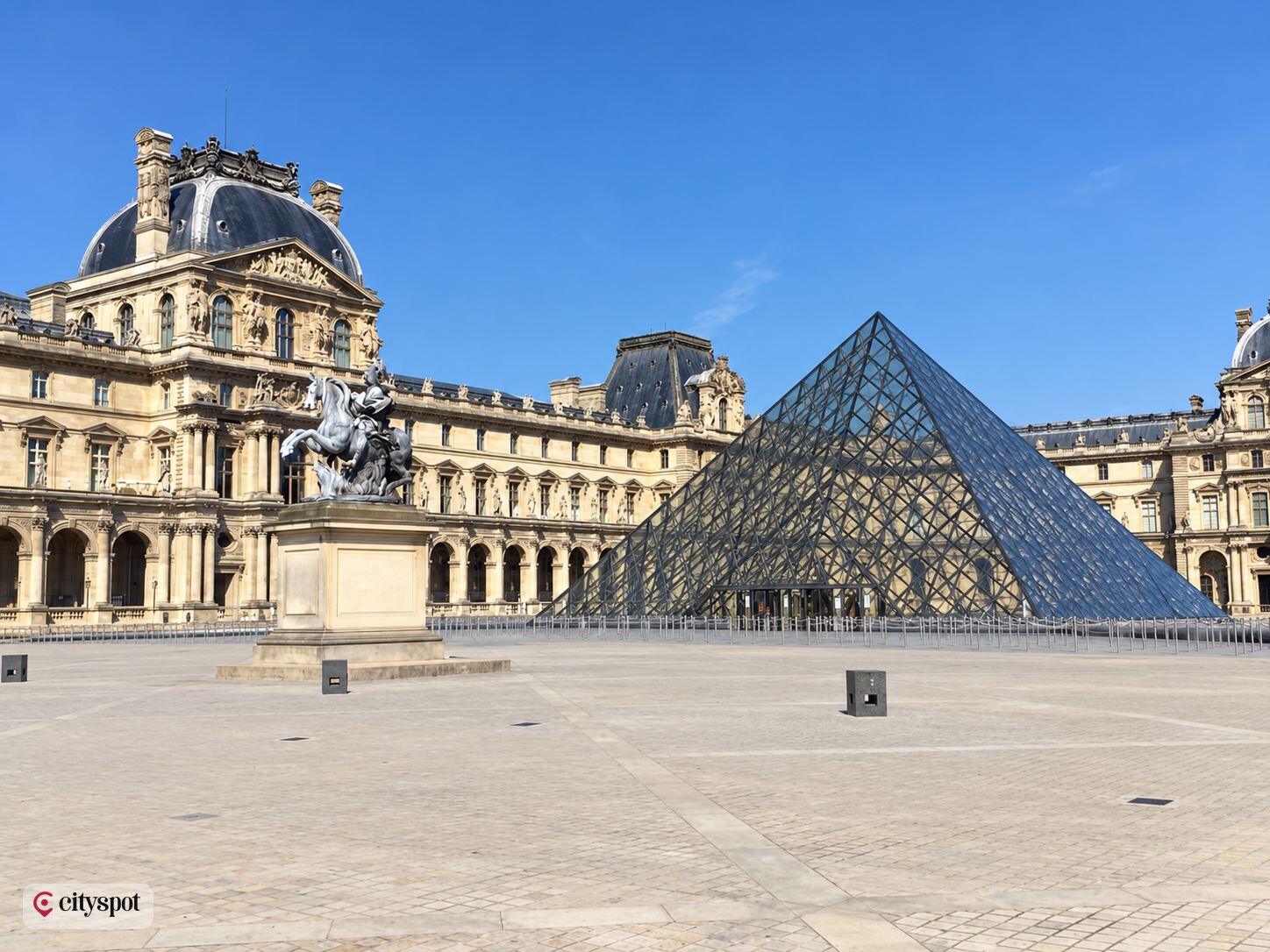
Louvre Pyramid — Photo: property of CitySpot
Right Bank · 1st arrondissement
Le Louvre & Jardin des Tuileries: From Medieval Fortress to the World's Most Visited Museum
The Louvre began around 1190 as a fortress built by King Philip II Augustus to guard the western approach to Paris. Charles V turned it into a royal residence in the 14th century, and in 1546 François I had the old keep torn down and began the Renaissance palace that later kings, Henri IV, Louis XIII, Louis XIV and Napoleon III, enlarged until it reached its present size. Louis XIV moved the court to Versailles in 1682, and the empty palace slowly filled with art collections before opening as a public museum on 10 August 1793, in the middle of the Revolution.
Today the Louvre is the most visited museum in the world, with about 35,000 works on display: Egyptian antiquities, the Venus de Milo, the Winged Victory of Samothrace at the top of the Daru staircase, and the Mona Lisa in the Denon wing. Most visitors enter through the glass pyramid designed by I. M. Pei in the Cour Napoléon and inaugurated in 1989 — fiercely criticized at first, now one of the best-known images of Paris. Book a timed ticket in advance, and remember that the museum is closed on Tuesdays.
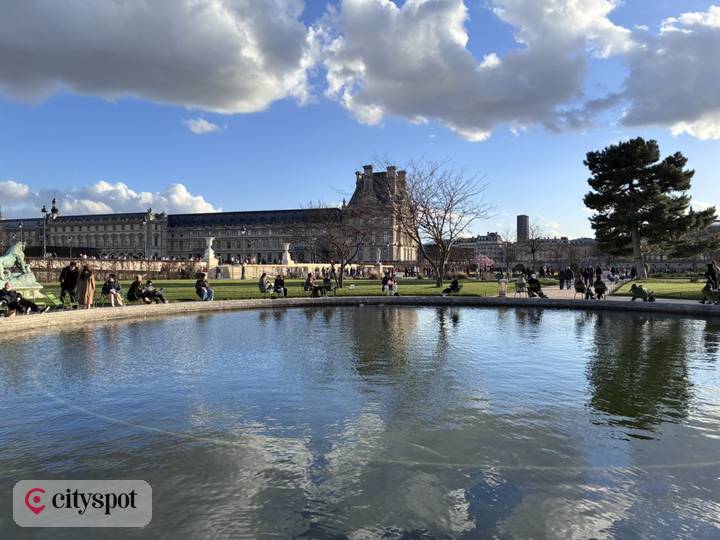
Walk west from the pyramid, past the Arc de Triomphe du Carrousel on the Place du Carrousel, and you step into the Jardin des Tuileries. Catherine de' Medici had the Tuileries Palace built here from 1564, on the site of old tile kilns (tuileries, in French), and André Le Nôtre redesigned the garden in 1664 for Louis XIV. Its gravel paths, green metal chairs and octagonal Grand Bassin pond make it the city's favorite place to sit and watch the clouds over the Louvre, with long tree-lined alleys running toward the Place de la Concorde.
At the Place de la Concorde end of the garden, the Musée de l'Orangerie shows Claude Monet's Water Lilies in two oval rooms, and the Jeu de Paume, at 1 Place de la Concorde, hosts photography and contemporary art exhibitions. Along the northern edge, the arcades of rue de Rivoli shelter souvenir shops and the Angelina tearoom at no. 226, famous for its thick hot chocolate, while the Musée des Arts Décoratifs at no. 107 occupies the Marsan wing of the Louvre. In summer, a fair with a giant Ferris wheel sets up along the rue de Rivoli side of the garden.
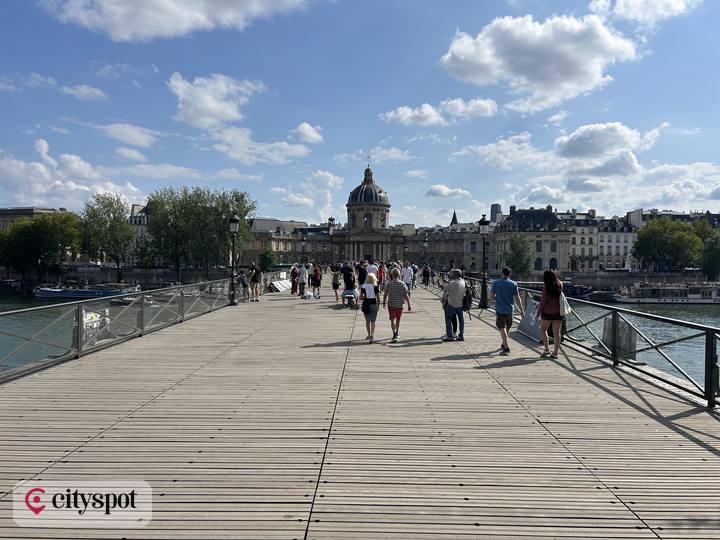
From the Louvre's courtyards, the Pont des Arts crosses the Seine to the Institut de France, whose dome closes the view from the bridge. Opened in 1804 as the first iron bridge in Paris, this pedestrian-only footbridge was long covered with thousands of “love locks” clipped to its railings, until the city removed them in 2015 and replaced the railings with glass panels. It remains one of the most pleasant places to cross the river on foot.
More from the history books
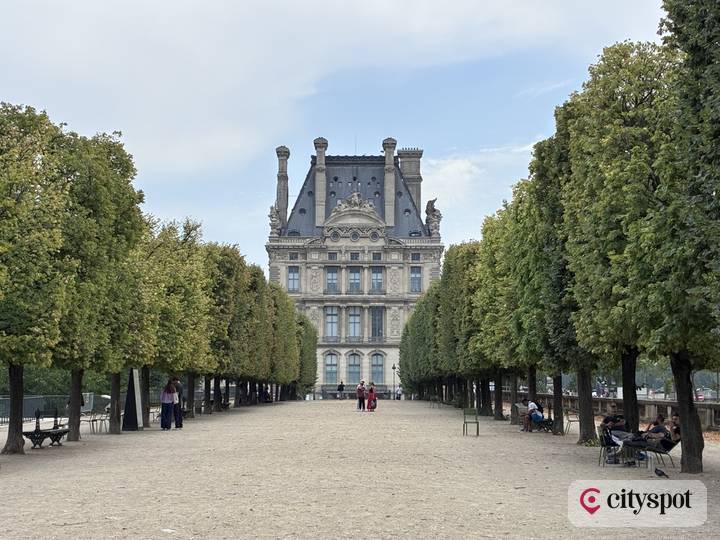
The Tuileries Palace was both a royal residence and a stage for the Revolution: Louis XVI and his family were forced to live there from October 1789, and the palace was stormed on 10 August 1792. It stood at the western end of the Louvre until the Paris Commune of May 1871, when it was set on fire; the ruins were demolished in 1883, opening the long perspective known as the Axe historique, which runs from the Louvre through the Place de la Concorde and up the Champs-Élysées to the Arc de Triomphe.
The garden has seen its share of firsts. On 1 December 1783, Jacques Charles and Nicolas-Louis Robert took off from the Tuileries in the first manned hydrogen balloon flight, in front of a vast crowd. At the other end of the Louvre courtyard, the Arc de Triomphe du Carrousel, built for Napoleon in 1808, was first topped with the gilded horses of Saint Mark's Basilica in Venice, taken as war booty in 1797 and returned in 1815; the bronze quadriga that replaced them was added in 1828.
3 key numbers
1793 — the year the Louvre opened as a public museum, in the middle of the French Revolution
673 glass panes make up I. M. Pei's pyramid, inaugurated in 1989
About 35,000 works are on display, from a collection that counts hundreds of thousands
We recommend…
- 📍 Musée du Louvre — Rue de Rivoli · Metro: Palais Royal–Musée du Louvre
- 📍 Arc de Triomphe du Carrousel — Place du Carrousel · Metro: Palais Royal–Musée du Louvre
- 📍 Musée de l'Orangerie — Jardin des Tuileries · Metro: Concorde
- 📍 Jardin des Tuileries — Rue de Rivoli · Metro: Tuileries
- 📍 Angelina — 226 rue de Rivoli · Metro: Tuileries
Did you know?
- In August 1911 the Mona Lisa was stolen from the Louvre by Vincenzo Peruggia, an Italian who had worked at the museum; it was found in Florence in 1913, and the theft made the painting world-famous.
- The Tuileries are named after the tile kilns (tuileries) that stood on the site long before Catherine de' Medici built her palace there.
- The Carrousel arch, the obelisk of the Place de la Concorde and the Arc de Triomphe all stand along the same long perspective, the Axe historique.

Explore Le Louvre & Jardin des Tuileries with CitySpot
Download the CitySpot app and turn your phone into an audio guide to discover 500 points of interest in Paris, as well as many themed walking tours across the city.