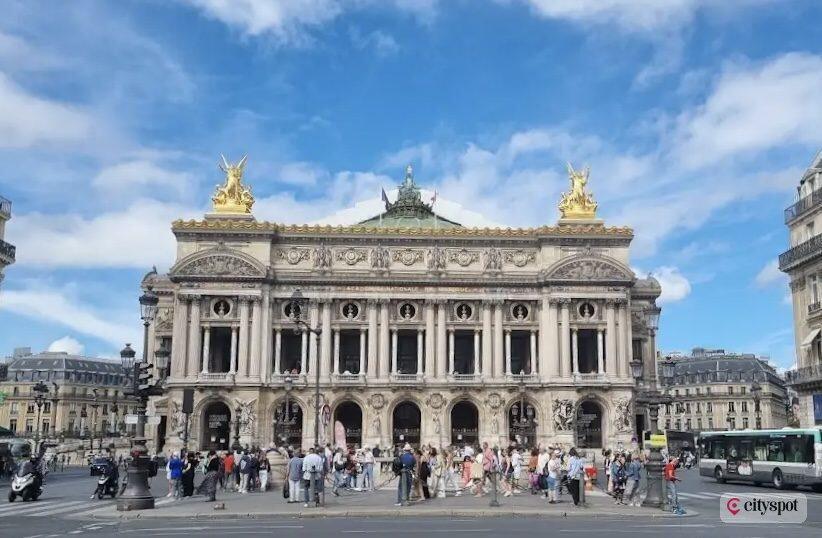
Palais Garnier (Paris Opera) — Photo: property of CitySpot
Right Bank · 9th arrondissement
Opéra & Grands Boulevards: Haussmann's Stage Set for Parisian Splendor
Baron Haussmann's 19th-century renovation of Paris carved the wide Grands Boulevards through the dense old city, demolishing entire medieval neighborhoods to do it. The Palais Garnier opera house, completed in 1875 after fifteen years of construction and more money than anyone expected, became their centerpiece and the grandest theater in Europe, a building so lavish that its architect reportedly couldn't explain its style except to call it "Napoleon III."
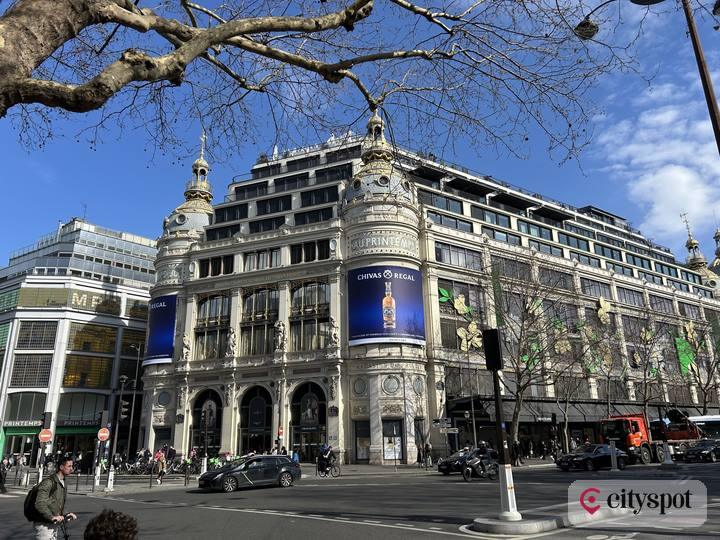
Tour the Palais Garnier's gilded auditorium and the underground cistern that inspired "The Phantom of the Opera," browse the grand department stores Galeries Lafayette and Printemps, both worth a visit for their glass-domed architecture alone, and catch a show at one of the boulevards' historic theaters. Few places in Paris feel quite so deliberately, unapologetically opulent.
Place de l'Opéra is the hub of the Grands Boulevards. Boulevard Haussmann is lined with department stores: Galeries Lafayette at no. 40 and Printemps at no. 64. To the east, boulevard Montmartre opens onto two covered passages, Jouffroy (no. 10) and des Panoramas (no. 11), while rue Drouot is home to the Hôtel Drouot auction house at no. 9.
Novelist Gaston Leroux set "The Phantom of the Opera" around a real underground cistern beneath the Palais Garnier, built to stabilize its marshy foundations and still used today by the Paris fire brigade for diving training. Its "lake" is entirely real, and although no phantom has ever been confirmed, a chandelier counterweight genuinely did crash through the ceiling in 1896, killing a stagehand and inspiring the book's most famous scene.
More from the history books
The Palais Garnier's construction was a saga in itself. Charles Garnier, then a little-known 35-year-old architect, won the 1861 competition, but the project was delayed first by the groundwater that flooded the foundations and then by the Franco-Prussian War, the Siege of Paris and the Commune. Napoleon III, who had commissioned the opera, never saw it finished: the Second Empire fell in 1870, and the building was finally inaugurated on 5 January 1875 under the Third Republic.
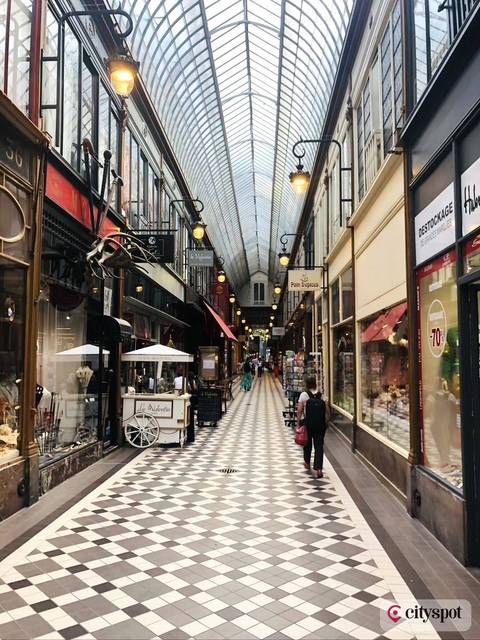
Long before the department stores, the area was shaped by the covered passages: the Passage des Panoramas, opened in 1799, was one of the first in Paris and gained gas lighting in 1817, while Passage Jouffroy, opened in 1847, later became home to the Musée Grévin. And on 28 December 1895, in the basement of the Grand Café on boulevard des Capucines, the Lumière brothers held the first paid public film screening in history, a moment that cinema historians treat as the birth of the medium.
3 key numbers
1,979 seats fill the Palais Garnier's gilded auditorium beneath its famous Chagall ceiling
15 years and 15 architectural styles were considered before Charles Garnier's design was chosen in a public competition
1912 — the year Galeries Lafayette completed its stained-glass dome, still one of the most photographed ceilings in Paris
We recommend…
- 📍 Palais Garnier — Place de l'Opéra · Metro: Opéra
- 📍 Galeries Lafayette Haussmann — 40 boulevard Haussmann · Metro: Chaussée d'Antin–La Fayette
- 📍 Passage Jouffroy — 10 boulevard Montmartre · Metro: Grands Boulevards
- 📍 Passage des Panoramas — 11 boulevard Montmartre · Metro: Grands Boulevards
Did you know?
- The Palais Garnier's grand staircase was deliberately oversized so the theater's wealthy patrons could see and be seen arriving — the social performance mattered as much as the opera itself.
- Marc Chagall's painted ceiling, added in 1964, was controversial at the time for covering the original 19th-century artwork — it was installed on a removable panel so the original could, in theory, be restored.
- Galeries Lafayette's dome contains over 1,600 square metres of stained glass, assembled without a single supporting column beneath it.

Explore Opéra & Grands Boulevards with CitySpot
Download the CitySpot app and turn your phone into an audio guide to discover 500 points of interest in Paris, as well as many themed walking tours across the city.